Corded vs. Cordless Detail Sander Power Output
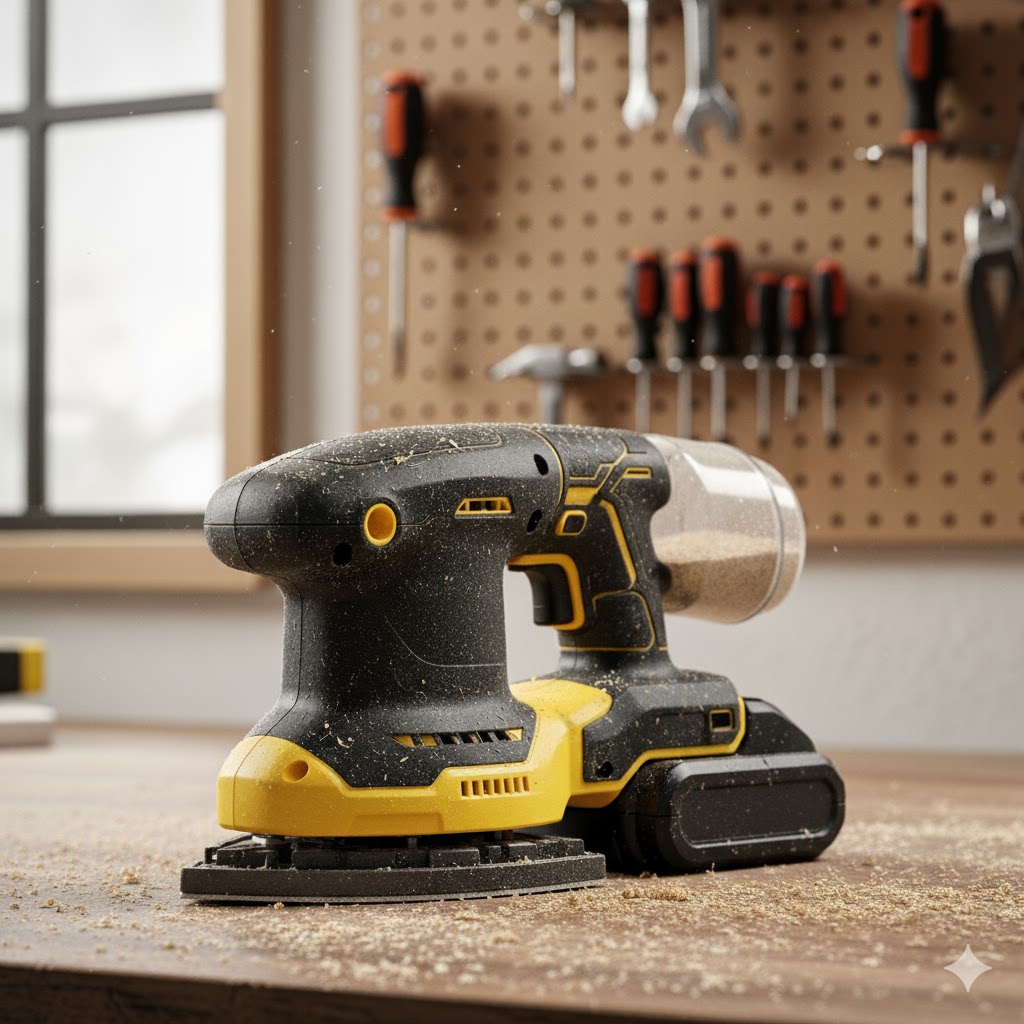
The box says 1.2 amps. The battery says 20 volts. One measures current flow. The other measures electrical potential. Comparing them is like comparing a river's depth to its speed - both describe water, neither predicts the other.
This is the situation with detail sanders. Corded models advertise amperage. Cordless models advertise voltage. The two numbers exist in different unit systems, measuring different physical quantities, and somehow consumers are expected to compare them at the point of purchase.
The Amperage Number
Most corded detail sanders draw 1.0 to 1.5 amps from a 120-volt wall outlet. Multiply those together and a 1.2-amp sander consumes 144 watts. That's the actual power consumption - continuous, unchanging, available from the moment you plug in until the moment you unplug.
The thermal capacity hides inside that rating too. A 1.5-amp motor handles extended sanding sessions because its windings, brushes, and housing dissipate heat at a rate that matches the current flowing through them. The number describes not just how much power the tool draws but how long it sustains that draw without cooking itself.
The Voltage Number
An 18-volt battery doesn't deliver 18 volts. Not really. Fully charged, it sits above 20 volts - which is how DeWalt can stamp "20V MAX" on what is electrically an 18-volt platform. Milwaukee calls theirs M18. Same cells, different marketing math.
The voltage drops as the battery discharges. Starts above nominal. Passes through 18 volts somewhere in the middle of the work session. Continues falling until the protection circuit kills the output around 14 to 15 volts to prevent cell damage. The tool experiences a power curve that slopes downward from the first trigger pull to the last.
Multiply that declining voltage by the current the motor draws under load - typically 5 to 7 amps - and peak power lands around 90 to 126 watts. Below the 144 watts the corded model delivers consistently. And dropping from there with every minute of use.
What the Operator Feels
On pine with 120-grit paper, the difference barely registers. Both tools oscillate the pad at roughly similar rates. Both remove material at the pace detail sanders are designed for - slowly, precisely, by intention.
Press into hardwood with 80-grit and the gap appears. The corded sander maintains its oscillation rate under load. The motor draws more current to overcome resistance, and the wall provides whatever current it asks for. The cordless sander's oscillation slows. The battery can't sustain higher current draw without voltage sagging further. The tool is asking for more power than the chemistry wants to give.
The difference compounds over time. An hour in, the corded tool performs identically to how it started. The cordless tool has lost voltage, gained internal resistance from battery heating, and the operator may have swapped batteries once already. Two hours in, the corded tool still hasn't changed. The cordless operator is on their third battery, and each fresh one feels noticeably better than the depleted one it replaced.
The Declining Power Curve
Here's what the specifications don't show: the shape of power delivery over a work session.
A corded sander draws a flat line. Same watts at minute one, minute thirty, minute sixty. The wall outlet doesn't get tired.
A cordless sander draws a curve. High power when fresh, gradually declining as battery chemistry does what battery chemistry does. Higher-end models include electronics that compensate - increasing current draw to maintain speed as voltage drops, essentially burning through the battery faster to preserve the illusion of consistent performance. The tool holds its feel at the cost of runtime.
Temperature bends the curve further. Cold batteries deliver less current. Hot batteries from rapid discharge lose capacity. The ideal operating window sits between 60 and 80 degrees Fahrenheit. A cordless sander in an unheated garage in January or on a sun-baked job site in July operates outside that window, and the power curve steepens.
The Weight You Carry
A corded detail sander weighs 2 to 3 pounds. The cord adds nothing to what your hand holds - gravity pulls on it, but elsewhere.
Cordless models weigh 2.5 to 4 pounds depending on battery capacity. The battery mounts behind the motor, shifting the balance point rearward, away from the sanding pad. The difference seems trivial on a workbench. Hold the tool overhead for fifteen minutes sanding a cabinet soffit, and that extra pound of rearward-biased weight recalibrates your opinion about trivial.
What Got Traded
The cord was a leash. It limited range, created trip hazards, demanded extension cords on job sites, and tethered the tool to wherever the nearest outlet happened to be. Cutting it meant accepting a different set of constraints - declining power, finite runtime, battery weight, platform costs.
For detail sanders specifically, the trade-off lands differently than for high-demand tools. A circular saw needs every watt it can get. A detail sander removes material slowly by design, whether corded or cordless. The power gap matters less when neither version is trying to be aggressive. The convenience of no cord often outweighs the power advantage that the work doesn't fully use.
The platform question looms larger than the power question. A detail sander that shares batteries with a drill, impact driver, and flashlight already in the truck makes economic sense regardless of whether its watts-per-minute technically trail the corded version. The tool doesn't exist in isolation. It exists inside an ecosystem, and the ecosystem has its own physics.