The History of Stanley Hand Planes
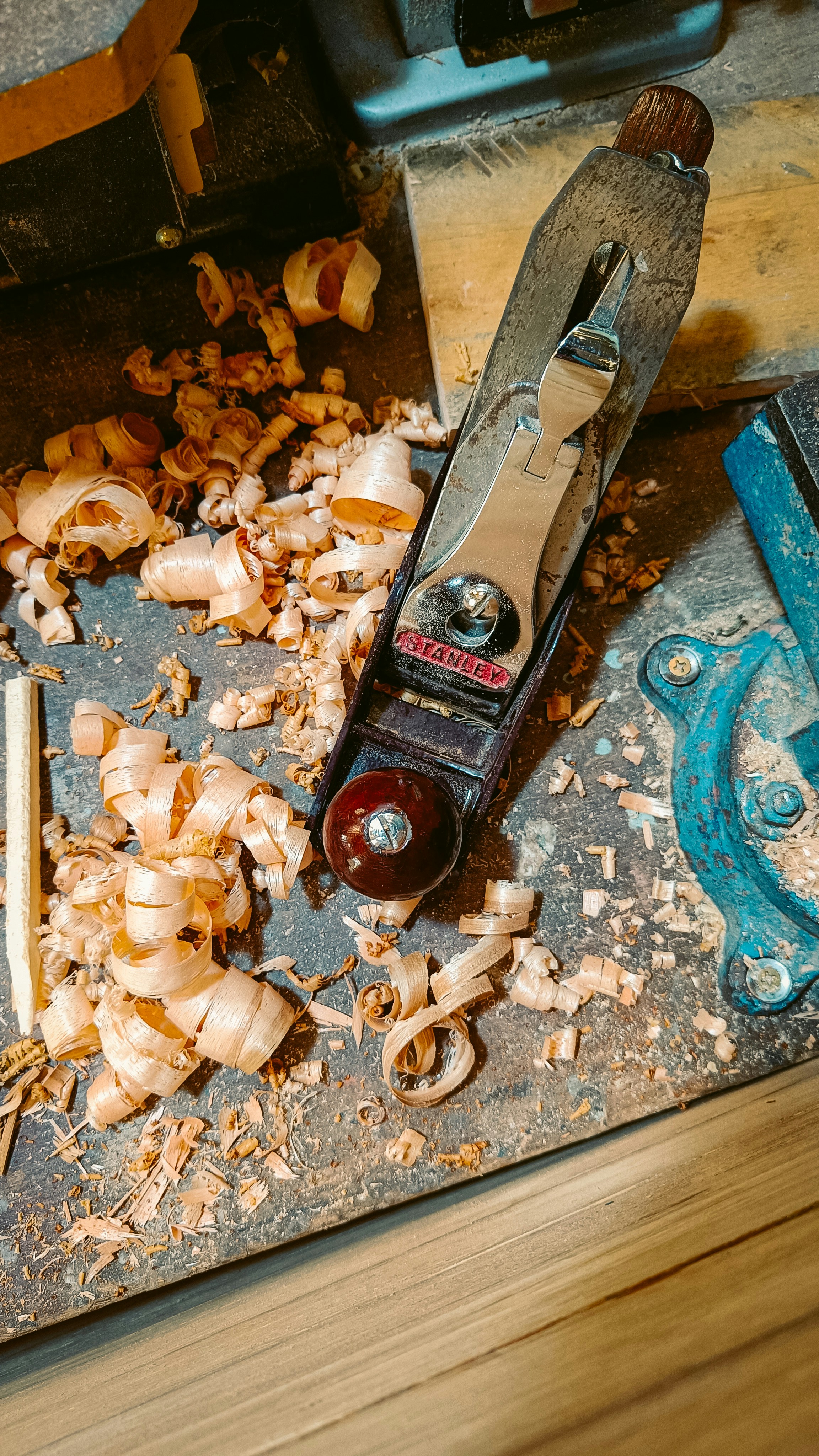
In 1867, a toolmaker named Leonard Bailey was fed up with wooden planes.
Not with the concept. Planes had been flattening wood for two thousand years and the geometry was fine. The problem was the adjustment. To change the cutting depth on a wooden plane, you loosened the wedge holding the blade, tapped the blade with a mallet - hopefully the right amount, in the right direction - then retightened the wedge. If the blade shifted during tightening (it usually did), you started over. Lateral adjustment - getting the blade parallel to the sole - involved the same maddening cycle of loosen, tap, hope, retighten.
Bailey's solution was so clean it feels obvious in retrospect: put a threaded rod through the plane body with a knob on the end. Turn the knob, the blade advances or retreats. Each full rotation moves the blade about 0.025 inches - roughly the thickness of six sheets of paper. Add a lateral adjustment lever that shifts the blade side to side without affecting depth. Both adjustments made with the plane fully assembled, instantly testable. No mallet. No wedge. No guessing.
US Patent 67,559. The document that changed every workshop on the planet.
Stanley Sees the Future
Stanley Rule & Level Company had been making rulers and levels since 1843. The name was literal - they made rules and levels. In 1869, they looked at Bailey's plane patents and saw something bigger than a clever mechanism. They saw a tool that could be manufactured identically in quantity, with interchangeable parts, using the mass production methods that were transforming post-Civil War American industry.
They bought the patents. They hired Bailey himself. And they started building.
The earliest Stanley-Bailey planes - what collectors now call "Type 1" - were rough by later standards. Basic castings, minimal ornamentation, crude adjustment mechanisms. But they worked. They cost less than premium wooden planes. And critically, the blade stayed where you put it. For a generation of woodworkers who'd spent their careers fighting wedge-held blades, that last point alone was worth the purchase price.
By 1875, Stanley's catalog had expanded from a handful of sizes to a full range of bench planes, block planes, and specialty planes. The tool that started as one man's frustration with mallet-adjusted blades was becoming an industrial standard.
The Numbers
Stanley's numbering system looks arbitrary until you learn where it came from. Bailey assigned numbers to his planes before Stanley acquired them - loosely correlated to size but without strict logic. Stanley kept his system and extended it. The numbers became a language.
No. 1 through No. 8 covers bench planes, small to large. The No. 1, at five and a half inches, was so small and so rarely useful that Stanley barely produced them. Collectors pay extraordinary prices for the few that survived. The No. 8, at twenty-four inches, was so large and heavy that only shipwrights and timber framers used it regularly.
The No. 4, at nine inches, became the standard smoothing plane - the default choice for finish work and general bench use. More No. 4 planes were manufactured than all other bench plane numbers combined. When someone says "Stanley plane" without qualification, they mean a No. 4.
The No. 5 jack plane became the workhorse - fourteen inches, designed for rough stock removal and initial flattening. Most professionals owned both a No. 5 and a No. 4 and used them as a pair. The No. 6 fore plane, at eighteen inches, occupied an awkward middle ground that most woodworkers skipped entirely. The No. 7 jointer, at twenty-two inches, was the one that created flatness on long boards and panel edges.
Then there were the fractional numbers. A No. 4-1/2 was a No. 4 with a wider blade and more mass - same nine-inch length, but heavier and more aggressive. A No. 5-1/2 became many woodworkers' single favorite plane - long enough for jointing, heavy enough for aggressive cuts, still manageable through a full day. The fractions extended through the series (3-1/2, 6-1/2, 7-1/2) with production volumes shrinking as the sizes grew.
Block planes got separate numbering in ranges that wouldn't collide with bench planes. The No. 9-1/2 became the standard block plane - probably the second most common Stanley plane after the No. 4. The No. 60-1/2, with its adjustable throat, became the fine-work favorite.
This numbering system became so embedded in woodworking culture that when premium manufacturers emerged a century later, they simply adopted Stanley's numbers. A Lie-Nielsen No. 4 means the same thing a Stanley No. 4 means. Bailey's somewhat arbitrary designations became the permanent vocabulary of hand planes worldwide.
The Sweet Spot: 1910 to 1945
Collectors and users agree on this much: Stanley planes manufactured between roughly 1910 and the end of World War II represent the high-water mark. The agreement isn't nostalgia. It's metallurgy.
The cast iron from this era - what metallurgists call gray iron, with carbon content around 3.2 to 3.4 percent - machines to smooth surfaces and dampens vibration effectively. The American foundries producing these castings were operating at peak capability, using established practices that produced consistent results. The rosewood used for handles came from old-growth sources, producing dense, stable wood with minimal grain runout that took shellac finishes beautifully and aged to deep patina.
But it wasn't just materials. The machining standards during this period show attention to surfaces that actually matter. Frog mating surfaces sit flat against the body. Blade bedding areas machine smooth and true. The adjustment mechanisms move through their range without binding. Threaded components fit precisely. These details indicate time spent in manufacturing and assembly - time that later decades would eliminate.
The Type Study - a classification system collectors developed to track production changes - recognizes roughly twenty distinct types spanning from Bailey's pre-Stanley production through the 1960s. Types 11 through 15, covering approximately 1910 to 1945, represent the sweet spot. Type 11 introduced the kidney-shaped lever cap hole. Types 12 through 15 maintained these refinements through peak production. Each type represents a cluster of manufacturing characteristics, and the characteristics from this era consistently show Stanley at full capability.
The war years - 1942 to 1945 - brought material substitutions as production resources went to the military. Painted lateral adjustment levers replaced polished ones. Handle designs simplified. Some planes show "SW" markings rather than full Stanley branding. These were adaptations to wartime constraints, not quality degradation in the fundamental sense. But they marked the beginning of manufacturing simplification that would accelerate in peacetime.
The Sheffield Chapter
Meanwhile, across the Atlantic, Stanley's British subsidiary in Sheffield was building planes with a different character.
The British operation used different foundries, different machining equipment, different labor practices - and the results were sometimes distinctly superior. Sheffield-made Stanley planes, marked "Made in England," typically feature denser, finer-grained cast iron. The blade steel specifications drew from Sheffield's centuries-old tradition of toolmaking steel that predated Stanley by generations.
British production developed its own following. The Type Studies that track Sheffield manufacturing run on a separate timeline from American classifications because the production changes happened at different times for different reasons. British planes from certain eras command premiums in European markets that exceed their American values, while American examples dominate US collector interest.
Production continued in Sheffield long after American plane manufacturing contracted - through the 1980s and into limited 1990s production. The last British-made Stanley bench planes represent the end of a manufacturing lineage that connected Bailey's 1867 patent to the city that had been making edged tools since the Middle Ages.
The Long Decline
The story of Stanley's decline isn't dramatic. There was no single catastrophic decision, no scandalous collapse. It was gradual, logical, and - if you understand the economics - almost inevitable.
Power tools won. Starting in the 1950s, electric routers, jointers, planers, and sanders could do in minutes what hand planes did in hours. Professional woodworkers switched. The market for hand planes contracted from hundreds of thousands of units annually to a fraction of that. Stanley responded the way any manufacturer would: reduce production costs to maintain margins on declining volume.
Type 19, spanning 1948 to 1961, shows the accumulation in slow motion. Handles shifted from rosewood to stained beech. Casting detail coarsened. Machining tolerances loosened incrementally. Plating quality on hardware decreased. No single change was catastrophic - the Bailey design proved remarkably hard to ruin completely - but collectively they represented a different manufacturing philosophy. Earlier production optimized for quality at affordable prices. Later production optimized for minimum acceptable quality at maximum cost reduction.
By the 1970s, hand plane production was a footnote in Stanley's business. Plastic handles replaced wood. Castings simplified. Blade stock thinned. Someone buying a Stanley plane in 1975 received a very different tool than someone buying in 1925, despite nearly identical appearance from across the room.
Stanley ceased domestic hand plane manufacturing in the late 1990s, moving what remained to overseas facilities. The name continues on planes. The connection to the American manufacturing tradition that ran from 1869 through the twentieth century does not.
The Collectors and the Users
The market for vintage Stanley planes operates on economics that would baffle anyone unfamiliar with tool collecting. A well-preserved Type 11 No. 4 from 1915 sells for multiples of what a brand-new Stanley plane costs. A Type 11 No. 1 - rare to begin with, tiny, nearly useless for actual work - commands prices fifty times higher than a comparable-condition No. 4.
This isn't purely nostalgia driving the market. Users - woodworkers buying planes for actual cutting - pay premiums for pre-war Stanley planes because the manufacturing differences affect performance measurably. The blade seats more solidly. The adjustment mechanism operates more smoothly. The frog mates more precisely to the body. A restored 1920s plane with honest wear and a sharp blade performs alongside premium modern planes costing several times more.
The collector side layers additional value on top of functional worth. Original finish condition, completeness of parts, specific type characteristics, rarity of model - these factors create the stratospheric prices for museum-quality examples. A pristine Type 11 with intact original japanning and flawless rosewood tote occupies a different market than a functionally identical plane with worn finish and replaced handle.
The interesting gap is between these markets. Cosmetically rough planes with excellent mechanical condition - solid castings, flat soles, smooth adjustments - sometimes sell below their functional value because they don't satisfy collector criteria. Knowledgeable users target exactly these overlooked planes, acquiring professional-grade tools at a fraction of what pristine examples command.
A cottage industry of skilled restorers bridges the gap, acquiring damaged or incomplete planes, sourcing correct-era parts, and returning them to service. The economics work because restoration costs still fall below what pristine originals bring. These restored planes serve users who want vintage quality without top-tier collector prices.
The Patent That Won
Walk into any tool store today. Pick up any bench plane from any manufacturer - Stanley's current overseas production, budget imports from wherever, premium Lie-Nielsen or Veritas. Look at the mechanism. Threaded depth adjustment rod. Lateral adjustment lever. Chipbreaker pressed against blade by lever cap.
That's Bailey's patent. Still. After 158 years.
When Stanley's patents expired in the late 1880s and 1890s, competitors immediately started manufacturing Bailey-pattern planes. Sargent, Millers Falls, Union Manufacturing, British firms, eventually Japanese manufacturers, eventually everyone. The design was too good to compete against with anything fundamentally different. Premium modern manufacturers don't redesign the mechanism - they refine Bailey's execution using better materials, tighter tolerances, and modern machining capabilities. The core architecture is unchanged.
Stanley's numbering system became universal. Stanley's 45-degree bedding angle became standard. Stanley's blade dimensions became the specifications replacement blade manufacturers produce to. Stanley's handle profiles became the ergonomic template. Even Stanley's competitors standardized on Stanley's standards.
This is the remarkable thing about the Bailey patent and Stanley's century-plus of manufacturing it: the mechanism was so mechanically effective, so efficiently manufacturable, and so deeply embedded in market expectations that it eliminated virtually all competing approaches. No other hand tool mechanism achieved anything close to this level of dominance over this span of time.
Leonard Bailey was frustrated with wooden planes and invented something better. Stanley saw the potential and built it at scale. The workshop world standardized around their product so completely that "hand plane" and "Bailey pattern" became synonyms. The company's own story arced from peak to decline to legacy - but the mechanism Bailey patented in a Connecticut workshop in 1867 is still the mechanism in every bench plane sold anywhere on earth.
The design didn't just survive. It won so completely that alternatives stopped being attempted.