Types of Drill Bits
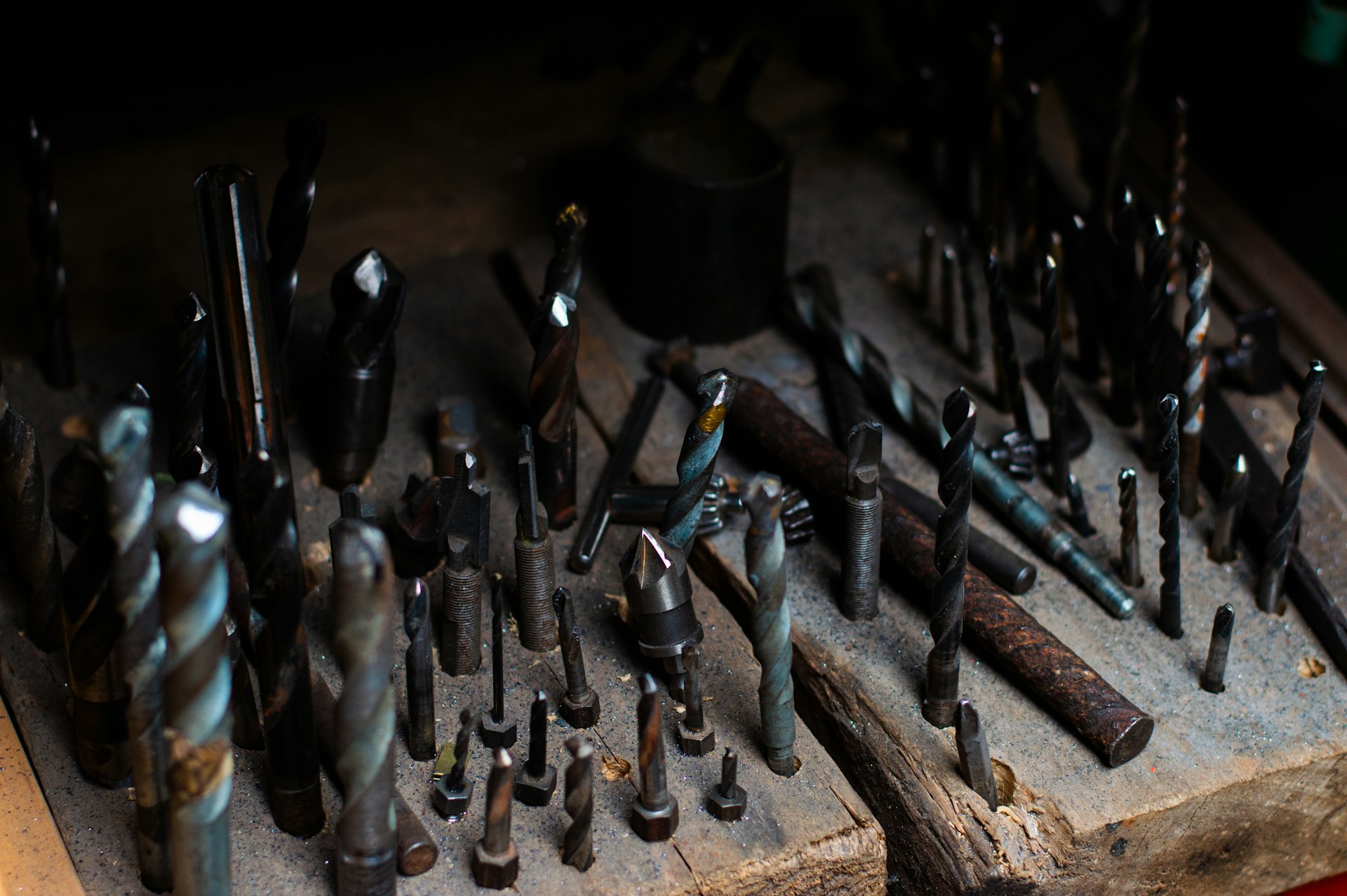
"Drilling a hole" sounds like one operation. It's closer to twelve. A twist bit boring through steel, a Forstner bit sinking a flat-bottomed pocket in walnut, a masonry bit fracturing concrete while a hammer drill pounds behind it - these processes share rotational motion and almost nothing else. The geometry of the bit determines everything about how material gets removed, and each geometry exists because someone encountered a specific problem and designed past it.
The hardware store drill bit aisle isn't a catalog. It's a museum of solved problems.
The Workhorse: Twist Bits
Steven Morse standardized this geometry in the 1860s and it hasn't fundamentally changed since. Two helical flutes spiraling up a cylindrical shaft, ending in a pointed tip. The flutes serve double duty - they provide cutting edges and they channel chips up and out of the hole. The point angle (118 degrees for general purpose, 135 degrees for harder materials) determines how the bit first bites into the workpiece.
The reason twist bits dominate is versatility. They drill wood, metal, plastic, and soft masonry with the same basic geometry. The material determines the specifics - coating type, point angle, flute pitch, speed, and pressure - but the underlying geometry handles all of it.
The size range borders on absurd. Micro bits smaller than a human hair for circuit board work. Fractional inch sizes following the numbered and lettered drill bit sizing system. Metric sizes in half-millimeter increments. Three different length standards. Multiple shank designs. All built on the same two-flute helix that a Civil War-era engineer figured out 160 years ago.
The Brute: Spade Bits
A flat paddle of metal with a sharp center point. The geometry is almost primitive - no flutes, no helix, just two cutting edges that scrape away material while the flat body pushes chips forward and sideways. They appeared in the 1960s as a faster, cheaper way to punch through framing lumber.
Spade bits exist because electricians and plumbers needed to drill hundreds of holes per day through studs and joists for running wire and pipe. Speed mattered. Hole quality didn't. The rough exit side, the tearout on the back face, the oversized holes - none of it matters when the hole gets covered by drywall.
Running electrical through a remodel with twist bits would take forever. Running it with spade bits takes a morning. The geometry is ugly by woodworking standards and perfect for construction standards. The choice between spade bits and auger bits for joists comes down to whether you need speed or clean holes through structural lumber.
The Precision Tool: Forstner Bits
Benjamin Forstner's 1874 design solved three problems simultaneously: flat-bottomed holes, overlapping holes, and drilling on angled surfaces without the bit walking sideways. The trick is a circular rim that scribes the hole perimeter before internal cutters remove the waste. The rim guides the bit rather than a center point, which means the bit doesn't need to follow a pilot hole and doesn't deflect into adjacent holes.
Forstner bits can do things other bits can't. Drill half an inch into a board and stop - you get a flat-bottomed pocket. Drill two holes that overlap and the bit doesn't deflect into the first hole. Start a hole on a 45-degree surface and the rim holds position instead of skating sideways.
The quality spread is extreme. Premium Forstner bits have thick rims and precision-ground cutters. Budget versions have thin rims that flex and rough cutters that tear grain rather than shearing it. The difference shows immediately in the hole. Few tool categories span such a wide gap between the cheap version and the good version.
The Self-Feeder: Auger Bits
The oldest design still in common use. Roman-era archaeology shows similar geometries. The modern version was standardized for hand braces in the 19th century, and the critical innovation was the threaded screw point - a lead screw that literally pulls the bit into the wood.
A hand brace doesn't generate much downward force. The auger bit doesn't need any. The screw point feeds itself forward, the spurs scribe the hole diameter, and the cutting edges lift chips up the spiral body. The entire system runs on rotational input alone. Power drills now provide enough force to make the feed screw unnecessary, so modern power augers often reduce or eliminate it - but the original design was solving the specific problem of drilling deep holes with minimal force.
Electrician's augers extended the concept with flexible shafts for drilling through multiple studs in line. Ship augers tightened the spiral for deep holes in timber. Bell hanger bits reach four feet long for punching through multiple floor joists. Each variant is the auger concept adapted to a specific trade's specific frustration.
The Woodworker's Compromise: Brad Points
A twist bit modified with a sharp center point and spurs at the outer diameter. The center point locates precisely. The spurs scribe the hole perimeter before the cutting edges engage. Cleaner than twist bits in wood. Faster than Forstner bits. Not as clean as either specialist, but good enough for most woodworking that isn't furniture-grade.
Brad points bridge the gap because most woodworking holes don't need Forstner precision. Shelf pin holes in a bookcase, dowel holes in a joint, pilot holes for screws - all cases where twist bit tearout is unacceptable but Forstner bit speed is unnecessary.
Sheet Metal's Solution: Step Bits
A conical bit with multiple cutting diameters in one tool. Each step is a different hole size. Drill deeper and the hole gets bigger. The geometry emerged from sheet metal work where drilling progressively larger holes through thin material is the entire job.
The cone shape self-centers. The following step deburrs the edge left by the previous step. One bit replaces a dozen twist bits for thin-material work. The limitation is exactly that - thin material. In anything thicker than about 1/8 inch, the stepped geometry can't produce clean holes because the step faces aren't designed for sustained cutting.
Cylinders for Large Holes: Hole Saws
A toothed cylinder that cuts an annular ring rather than removing all the material in the hole. Cutting only the perimeter makes large holes dramatically faster than any solid bit could manage - a 4-inch hole saw removes a fraction of the material that a 4-inch solid bit would have to.
A pilot bit in the center locates the hole. The tooth geometry varies by material - aggressive for wood, fine for metal, diamond-grit for tile where the material fractures rather than cuts. Large hole saws demand slow speeds and steady pressure or they bind and kick.
The Fracture Specialist: Masonry Bits
Masonry doesn't cut. It fractures. A masonry bit's carbide tip has chisel geometry rather than cutting edges. The bit rotates while a hammer drill impacts it thousands of times per minute. The combination of rotation and percussion cracks the material away in fragments rather than shearing it.
The flute design accommodates masonry dust - much finer and more abrasive than wood or metal chips. Wider flutes help clear the powder that would otherwise pack the hole and overheat the bit. SDS shanks replaced straight shanks for rotary hammers because the hammering mechanism needs a positive lock that a smooth shank can't provide.
Why There Are So Many
Every bit geometry in that hardware store aisle is someone's answer to a specific material removal problem. Twist bits solved general purpose but weren't clean enough for woodworking. Forstner bits solved clean flat-bottomed holes but were too slow for construction. Spade bits solved construction speed but couldn't make a presentable hole. Auger bits solved self-feeding for hand braces. Step bits solved the sheet metal worker's problem of multiple hole sizes in thin stock. Masonry bits solved the fact that concrete fractures instead of cutting.
The variety isn't complexity for its own sake. It's 160 years of tradespeople encountering limitations and engineers designing past them, one geometry at a time. Each bit shape carries the answer to a question that mattered enough for someone to solve.