How a Surgical Cutting Tool Became Construction's Swiss Army Knife
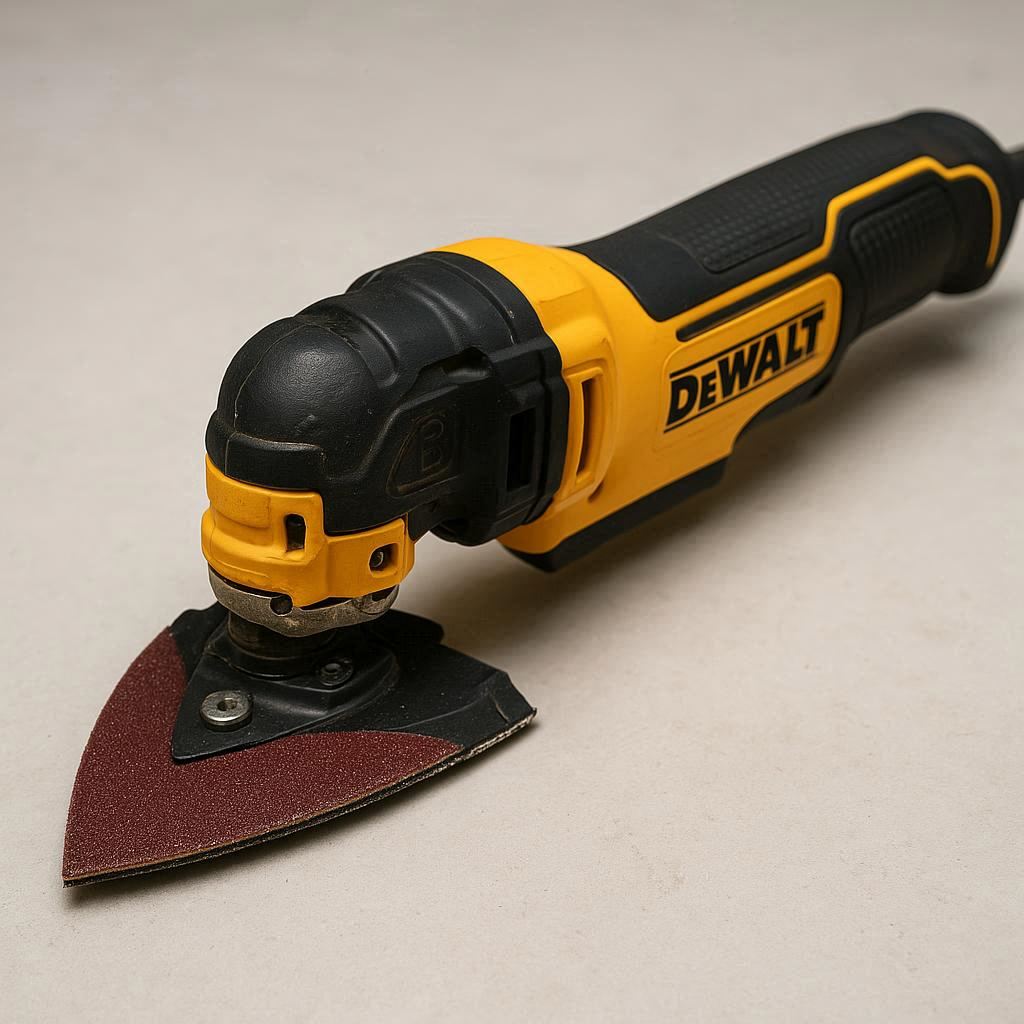
Fein invented the oscillating multi-tool in 1967 to cut plaster casts off broken limbs. The side-to-side motion - a blade swinging through 2.8 to 3.2 degrees of arc at thousands of oscillations per minute - could cut rigid material without cutting the soft tissue underneath. A medical tool.
Then someone brought one to a job site.
The remodeling industry discovered that the same oscillating motion that safely cut plaster casts also plunge-cut through drywall without hitting pipes, trimmed door casings flush against flooring, scraped adhesive off subfloors, and removed grout from tile joints. By the time Fein's patent expired in 2008, every major tool manufacturer had their own version. The multi-tool had become the duct tape of power tools - the thing you reach for when nothing else fits the situation.
Somewhere in that explosion of attachments, someone added a triangular sanding pad. The multi-tool could already oscillate. A pad would give it sanding capability. One more function for the do-everything tool. The engineering afterthought shows.
The Motion Mismatch
Detail sanders vibrate in small circular orbits. The triangular pad moves in tiny circles, 10,000 to 16,000 times per minute. Every part of the pad follows the same orbital path simultaneously, distributing force evenly across the surface. The motion was designed for sanding.
Multi-tools oscillate laterally. The attachment sweeps back and forth through its narrow arc. This creates directional force that pushes material side to side rather than distributing it circularly. The motion was designed for cutting and scraping, where lateral force is the point. Sanding with this motion works, but the force distribution differs from what a sanding-optimized tool produces.
The practical difference: detail sanders create more uniform surfaces. Multi-tool sanding leaves subtle lateral scratch patterns, particularly visible on softer woods like pine. On harder species, the difference diminishes. For rough sanding between coats or cleaning up old surfaces, the multi-tool's lateral motion works fine. For visible final surfaces, the detail sander's circular orbit produces cleaner results.
The Attachment Problem
A detail sander's pad is permanently mounted. The connection between motor and abrasive is rigid, direct, and consistent. The tool does one thing and every component serves that function.
Multi-tool sanding pads are one attachment among dozens. The quick-change system that lets you swap from cutting blade to scraper to sanding pad in seconds means the connection between motor and pad isn't as rigid as a dedicated mount. There's play. Under aggressive sanding, the pad can shift slightly in its mount. High-end models minimize this, but the fundamental trade-off remains: versatility costs precision at the attachment point.
The weight and balance differ accordingly. Detail sanders weigh 2 to 3 pounds with weight centered over the pad. Multi-tools weigh 3 to 4 pounds with the motor housing behind the attachment, creating different leverage. Consistent light pressure during fine sanding takes more attention with the multi-tool's balance point.
Dust collection tells the same story. Detail sanders were designed with dust extraction as a primary feature - onboard canisters, vacuum ports, aligned holes in pad and backing plate. Multi-tools might include dust extraction as an add-on, and many don't include it at all. The sanding attachment might have holes, but without a vacuum connection, dust falls onto the work surface and your lungs.
Why Both Survive
The multi-tool's sanding capability exists for the same reason its cutting and scraping capabilities exist: because during remodeling work, you need one tool that does acceptable work on a dozen different tasks rather than a dozen different tools that each do one thing perfectly. Swap the cutting blade for a sanding pad between operations without putting down the tool, changing outlets, or opening another case.
The detail sander survives because "acceptable" isn't always enough. When surface quality matters - final passes on visible furniture, careful sanding of new trim, precision work on delicate molding profiles - the purpose-built tool outperforms the do-everything attachment. The circular orbit, the rigid pad mount, the integrated dust collection, the optimized weight balance. Everything the detail sander does, it does because it was designed to do exactly that and nothing else.
The Fein that was built to safely remove plaster casts became the job site Swiss army knife. Adding a sanding pad was the most obvious move in the world. The sanding pad just can't change the fact that the tool underneath was designed for a different kind of motion, a different kind of force, a different purpose entirely. Sometimes the Swiss army knife's scissors work fine. Sometimes you need actual scissors.