How the Random Orbital Sander Changed Finishing (And What It Still Can't Reach)
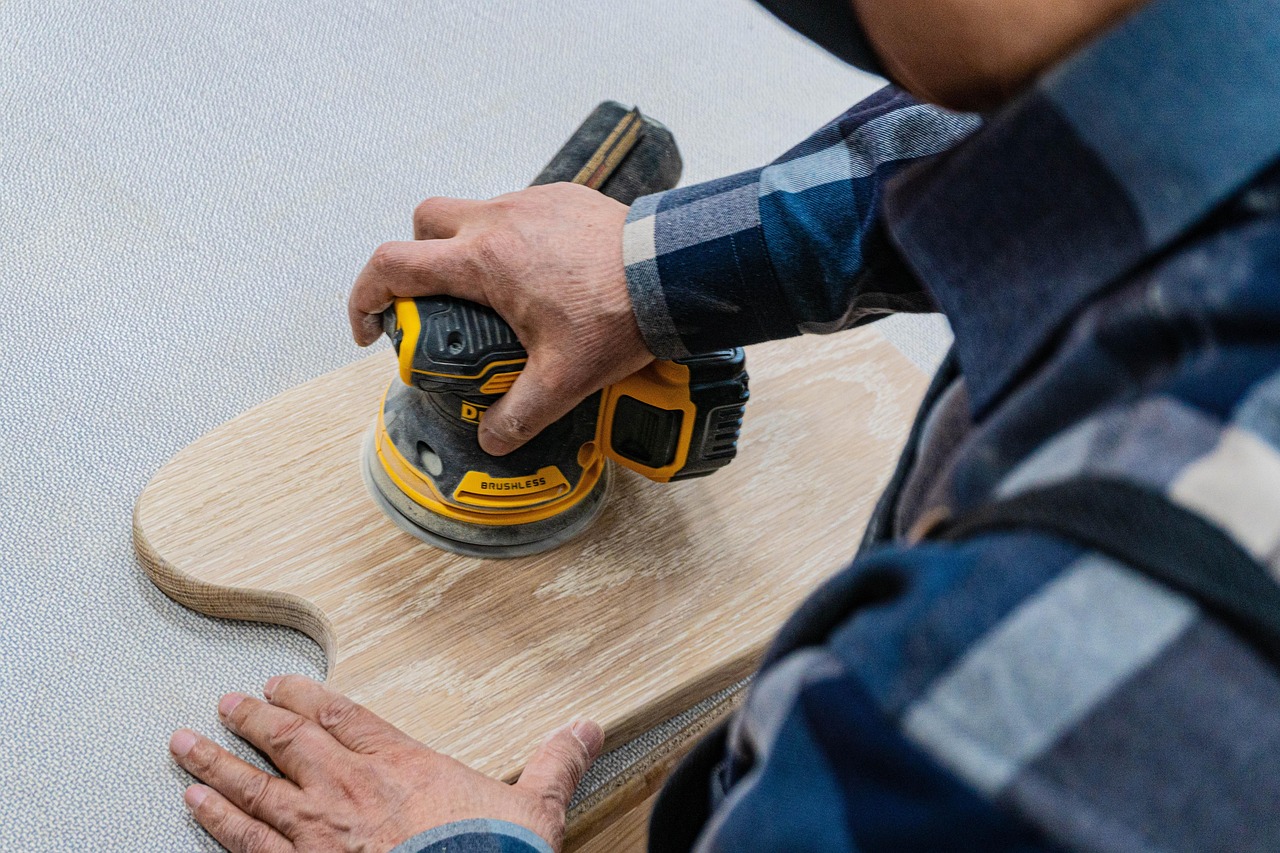
The random orbital sander appeared in 1968 when Italian manufacturer Rupes Tools brought the first commercial version to market. Before that moment, powered sanders either moved in straight lines (belt sanders) or vibrated in simple circles (orbital sanders). Both left marks. Belt sanders left scratches aligned with the belt direction. Plain orbitals left swirl patterns that showed under finish, especially on softer woods like pine.
Rupes added a second motion. The pad still vibrated in small circles, but now it also spun. No part of the abrasive traveled the same path twice. The scratch pattern became randomized - no directional marks, no swirl patterns, no evidence of the machine under a coat of finish. Automotive body shops adopted it first. Woodworkers followed. Within two decades, the random orbital had become the default power sander for surface preparation.
The Corner Problem
The circular pad that made random orbitals work also defined what they couldn't do. Five or six inches of round abrasive covers open surfaces efficiently but stops dead at any inside corner, any molding profile, any space tighter than the pad's radius. The geometry that randomized the scratch pattern also guaranteed dead zones wherever surfaces met at angles.
The detail sander emerged from that gap. A triangular pad, small enough to reach into 90-degree corners, vibrating in simple orbital circles without the random spin. The motion was a step backward - pure orbital vibration, the kind that preceded Rupes's innovation. The pad geometry was a step forward - a pointed tip that went where circular pads couldn't.
The trade-off was built into the design from the start. Detail sanders sacrifice the random scratch pattern for geometric reach. Under strong raking light on softer woods, the simple orbital motion shows faint directional patterns. The circular motion that gives random orbitals their invisible finish requires a circular pad. The triangular pad that solves the corner problem can't physically produce random orbital motion.
Two Evolutionary Branches
The two tools diverged from a common ancestor - the vibrating pad sander - and never reconverged. Random orbitals optimized for surface area, scratch pattern, and material removal rate. Motors run 2.0 to 3.0 amps driving both spin and orbit simultaneously. The five-inch pad contacts twenty square inches of surface. Production sanding of large panels, table tops, cabinet faces - the tool does in minutes what hand sanding takes hours to accomplish.
Detail sanders optimized for access and precision. Motors run 1.0 to 1.5 amps because simple vibration needs less power than dual motion. The triangular pad covers maybe three square inches. But those three square inches include the pointed tip that reaches where twenty square inches of circle cannot. Some models accept finger attachments that extend the point into even narrower profiles, reaching between chair spindles or into fluted moldings.
The paper tells the story too. Random orbital discs come in standard five-hole or eight-hole patterns, cheap and universally available. Detail sander triangles cost more per sheet, come with a diamond cutout at the tip for flipping worn points, and use hook-and-loop backing you can't replicate by cutting standard sandpaper. The paper ecosystem alone keeps the tools distinct.
What the Wood Sees
The mechanical difference shows up in the finished surface. Random orbitals produce microscopic scratch patterns that don't align with any direction. Sand across the grain and the cross-grain marks get buried in the randomized pattern. This is why the tool dominates surface preparation - grain direction becomes largely irrelevant.
Detail sanders leave subtle orbital patterns visible under strong light. On softwoods like pine, the pattern shows more readily than on harder species because the softer cellular structure responds differently to vibration. Oak and maple hide the marks better. This means the detail sander works best as a finishing tool after the random orbital has done the heavy work - reaching into corners and transitions that the circular pad missed, rather than preparing entire surfaces from rough.
The relationship between the two tools mirrors the pattern across hand tool evolution. The random orbital sander didn't make the detail sander unnecessary any more than the smoothing plane made the block plane redundant. Each tool exists because of a geometric constraint the other can't overcome. Circular pads cover area. Triangular pads reach points. Neither shape can do what the other does, and the 1968 innovation that changed everything about surface sanding changed nothing about corners.